 GxPSoft AI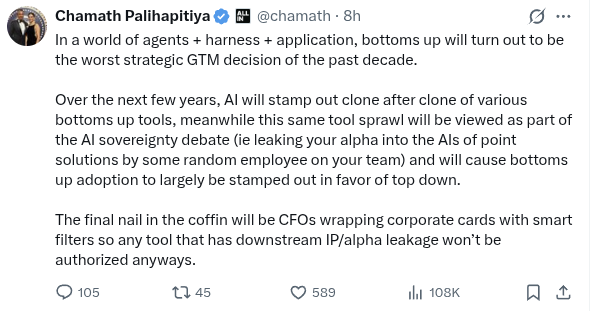
Chamath Palihapitiya published a post this summer arguing that the AI era makes “bottoms-up” product-led growth the worst GTM decision of the past decade. The post in full:
In a world of agents + harness + application, bottoms up will turn out to be the worst strategic GTM decision of the past decade.
Over the next few years, AI will stamp out clone after clone of various bottoms up tools, meanwhile this same tool sprawl will be viewed as part of the AI sovereignty debate (ie leaking your alpha into the AIs of point solutions by some random employee on your team) and will cause bottoms up adoption to largely be stamped out in favor of top down.
The final nail in the coffin will be CFOs wrapping corporate cards with smart filters so any tool that has downstream IP/alpha leakage won’t be authorized anyways.
His argument has three layers, and the post names them in order: AI agents + a “harness” layer + applications will rapidly clone single-purpose tools into commodity. Every point tool with embedded AI is a vector for proprietary data leaking into a third-party model — he calls this the “AI sovereignty” debate. CFOs will wrap corporate cards with smart filters that block any SaaS vendor exhibiting downstream IP-leakage risk, and the funnel goes top-down.
In horizontal SaaS, the post is provocative. In life sciences, it is directionally correct, mechanically incomplete, and arriving late.
The Stack Flip — Where Intelligence Lives
The deeper move in Chamath’s argument is not really about GTM. It is about where intelligence lives in the software stack. Today:
User
   │
Single-purpose Application
(QMS, LIMS, ELN, CRM, …)
   │
Business Logic
   │
Database
Tomorrow, in his model:
User
   │
AI Agent / Agent Harness
   │
Enterprise APIs
(QMS, LIMS, ERP, MES, …)
   │
Databases
Applications do not disappear. Their role changes. They become the authoritative database, the workflow engine, the audit trail, the permissions layer, and the API surface. The AI becomes the user interface.
That distinction is the load-bearing claim. If the agent does the work and the application only holds the controlled data and audit trail, then:
- The moat in regulated software is not the UI. The agent replaces the UI.
- The moat is API depth, data-model quality, audit granularity, and validation pedigree.
For life sciences vendors, this is the real headline. The features of the user interface are no longer the differentiator. The depth of the controlled record — the audit trail, the e-signature, the validated state of the workflow — is what survives the agent rewrite.
The Three Forces Land Simultaneously
Chamath identifies three forces. In life sciences, they hit at once, but each one has a different regulatory translation:
1. The cloning force → re-architecture, not replacement. AI can clone a LIMS cheaply. It cannot cheaply produce the proof of fitness for GxP use: validation documentation, 21 CFR Part 11 audit trails and e-signatures, ALCOA+ data integrity, vendor qualification history, inspection track record. Crucially, if a regulated company replaces a qualified system with an AI-built clone, the company inherits 100% of the validation liability and loses the vendor’s audit history. The vendor gets cloned; the buyer cannot transfer the audit. That asymmetry is the entire reason the cloning force bites shallowly on systems of record.
What you actually see is three simultaneous moves: in-house agent apps absorb the non-GxP long tail under GAMP 5 / CSA risk tiers; incumbents embed agents so cloning is unnecessary; and single-purpose vendors get absorbed into suites (Benchling’s ELN → R&D cloud expansion is the archetype).
2. The sovereignty force → already institutionalized as vendor qualification. “AI sovereignty” is not a new conversation in GxP. It is the existing compliance machinery — qualification audits of AI vendors, zero-retention / single-tenant / on-prem model deployments, contractual bans on training on customer data, egress controls — extended to model providers.
The interesting inversion is what gets purged. In horizontal SaaS, the sprawl problem is shadow SaaS. In life sciences, the sprawl problem flips from shadow SaaS to shadow AI. The audit finding waiting to happen is no longer “a scientist bought an unauthorized QMS.” It is “a scientist pasted a proprietary compound structure into ChatGPT.” The remedy — consolidation onto a governed harness — is the same one QA always wanted for tools.
3. The CFO smart-filter force → redundant with QA’s filter, lethal to the long tail. Life sciences already has the smart filter. It is called the validated system list. Nothing touches GxP data unless it is a qualified system, with a documented IQ/OQ/PQ, a vendor audit on file, and a periodic review cycle. The CFO card control is therefore incremental — but it is decisive for the non-GxP long tail, which is exactly where bottoms-up adoption lived. That is the layer that gets stamped out.
The “Alpha” Is Different Here
In tech, “alpha leakage” means losing a sales playbook or a roadmap. In life sciences, the alpha is the product:
| Tool | What it holds | Why it is the alpha |
|---|---|---|
| ELN | Experimental protocols, molecular structures, assay results, failed experiments | Drug discovery data, structure-activity relationships, negative results that prevent patent landmines |
| LIMS | Sample lineage, analytical methods, batch records, stability data | Manufacturing processes, QC specifications, regulatory submission data |
| QMS | Deviations, CAPAs, change controls, supplier audits, audit trails | Compliance posture, manufacturing risk profile, inspection readiness |
| eTMF / CTMS | Clinical trial protocols, investigator correspondence, regulatory submissions | Clinical strategy, patient safety signals, competitive trial design |
| EDC / CDMS | Patient-level clinical data, biomarker data, adverse events | The evidentiary basis for drug approval and label expansion |
A single drug candidate can represent $2–4 billion in R&D investment. Leaking even partial information about mechanism of action or formulation into a multi-tenant AI model is not just competitive — it is a potential regulatory data-integrity issue.
This is why Veeva, Benchling, and Sapio are all racing to say “private AI inside our trust boundary.” A random AI note-taker integrated into your ELN that sends data to OpenAI by default will not pass InfoSec review in 2026. The AI sovereignty debate will be enforced by QA and Regulatory, not by IT alone.
The Vulnerability Map
Clone-out exposure is inversely proportional to how much demonstrated control a product embodies. UI was the bottom-up wedge — and UI is precisely the layer AI commoditizes.
| Layer | Examples | Clone-out exposure | Why |
|---|---|---|---|
| Long-tail tools of insight / engagement | GraphPad/Spotfire-style analytics, sequence design, reference mgmt, simple trackers | Highest | Non-GxP, no validation moat, first to be absorbed by in-house agent apps |
| ELN | Benchling, LabArchives, Dotmatics, IDBS | High–medium | The notebook UI is exactly what an agent replaces; survival path is platformization |
| LIMS | LabWare, STARLIMS, LabVantage, SampleManager | Medium | Sample-workflow UIs cloneable; instrument integrations, chain of custody, Part 11 audit trails, validation packs are not |
| QMS | Veeva Vault QMS, MasterControl, ETQ, TrackWise | Medium–low | CAPA / change-control orchestration is the governance system regulators expect; AI clones the authoring layer, not the controlled backbone |
| Inspection-critical systems of record | CDS (Empower), MES (PAS-X), EDC (Medidata), pharmacovigilance (Argus) | Low | Deeply embedded, submission-critical, enormous switching + revalidation cost |
The pattern is clear. The ELN layer is most at risk because the scientist-facing UI is exactly what an agent replaces (“dictate the entry, the agent structures it”). The QMS layer is least at risk because CAPA orchestration and change control are the governance system regulators expect to see. Inspection-critical systems — Empower, PAS-X, Medidata Rave, Argus — are essentially unmovable for the duration of an active submission.
Shadow AI Is the Real Sprawl
Chamath’s “Shadow AI” framing matters more for life sciences than for any other vertical. The shadow-adoption story in a regulated shop is not “a scientist buys an unauthorized LIMS.” It is “a scientist pastes proprietary data into ChatGPT to write a Python script, draft an SOP, or summarize clinical literature.” Shadow-AI spending at some enterprises is reported at 4–9% of total SaaS spend and 2–3× the formal AI budget. In a financial firm, dozens of unapproved AI tools were found in use.
In life sciences, this is catastrophic for three specific reasons:
- Compliance blind spots. FDA requires lab data to meet ALCOA+ standards — Attributable, Legible, Contemporaneous, Original, Accurate, Complete, Consistent, Enduring, Available. When raw data passes through an unvalidated AI tool, chain-of-custody breaks and compliance becomes impossible to prove.
- Audit nightmares. During a regulatory audit, if the company cannot produce a complete, immutable lineage from raw instrument readout to the final AI-generated summary, they face Form 483s, warning letters, product recalls, or manufacturing shutdowns.
- Data integrity crises. AI tools may “optimize” or “summarize” raw spectral or chromatographic data unpredictably, destroying the originality required for regulatory submissions.
The defense pattern is more aggressive than the CFO card control alone. AI-specific DLP tools (Nightfall, Strac, Microsoft Purview) sit on the network and block text containing chemical structures, patient identifiers, or clinical trial codes from being pasted into external AI tools. Labs that currently connect LIMS to OpenAI via Zapier for auto-report generation will see those connections severed. Inside sanctioned ELNs, the clipboard will be disabled and screenshots blocked. The zero-trust architecture is not aspirational — it is the only durable answer.
The End-State Architecture — Systems of Record Become Systems of Control
The most consequential shift for QMS, LIMS, and ELN is architectural. In an agentic lab, the human talks to the agent; the agent executes the workflow; and the legacy system becomes the control layer the agent writes to, signs against, and is audited by — middleware for compliance rather than a UI for humans.
                Scientists / QA / QC / Manufacturing
                              │
                  Natural Language Interface
                              │
              Enterprise AI Agent Harness
   ┌──────────────────────────────────────────────┐
   │ Planning │ Policy │ Validation │ Memory      │
   │ HITL │ Observability │ Guardrails │ Routing  │
   └──────────────────────────────────────────────┘
                              │
                      MCP / Enterprise APIs
                              │
   ┌──────────────────────────────────────────────┐
   │ QMS │ LIMS │ ELN │ MES │ ERP │ PLM │ CTMS    │
   │ DMS │ Historian │ EMS │ LMS │ Others         │
   └──────────────────────────────────────────────┘
                              │
                Systems of Record & Audit Trails
This flips competitive logic in three ways:
- You compete on API depth, data-model quality, audit granularity, and validation pedigree — not UI delight. A QMS whose only differentiation is a nicer CAPA screen loses to an agent that calls the API. A QMS that owns the controlled-data and attribution layer gains leverage because every agent action needs a compliant place to land.
- ALCOA+ forces a design constraint Chamath’s stack ignores. Autonomous agents cannot hold accountability. Agent actions must be credentialed, logged, and countersigned like instrument/system events. That requirement is a moat for control-layer incumbents.
- MCP becomes the product. Today’s purchasing question is “does it support CAPA?” Tomorrow’s is “can autonomous agents execute CAPAs? Can MCP expose deviations? Can agents submit electronic signatures? Can agents retrieve audit history?” If your QMS has poor APIs, agents cannot use it.
The agent promise — read ELN → check inventory in LIMS → write execution in LES → create deviation in QMS → update batch record — is impossible without a common data backbone. That is why the platform push is real: Veeva Vault (QMS + LIMS + CTMS + eTMF on one Vault), Benchling (ELN + LIMS + Registry + In Vivo on one data backbone), Sapio (ELN + LIMS + QMS + ELaiN). The winner is not “the best ELN.” It is the platform that can serve as the Harness — the GxP-validated system of record where agents can run with permissions.
CSV Shifts — Validate the Harness, Not Just the App
If work increasingly happens through an AI harness, the validation boundary shifts. Instead of validating:
User → MasterControl UI → CAPA CreatedYou may validate:
User Request
   → AI Planner
   → Policy Engine
   → Approved MCP Tool
   → MasterControl API
   → CAPA Created
   → Electronic Signature
   → Audit Trail
The AI harness itself becomes part of the validated ecosystem. New validation artifacts emerge:
- Model and prompt version control (model registry, prompt templates as configuration items)
- Tool-registry qualification (every MCP server is a validated integration)
- Golden test suites for regulated workflows
- Deterministic policy checks before actions (binary gates, not “be safe” prompts)
- Human approval gates for GxP-impacting operations
- Continuous evaluation after model or prompt updates
- End-to-end traceability of reasoning inputs, retrieved evidence, tool calls, and outputs
This aligns with the CSA-era emphasis on risk-tiered validation: focus effort on higher-risk automated decisions while relying on automated testing and monitoring for lower-risk behavior. The standing position — and the principle we have built around — is that probabilistic guardrails fail on the failure modes that matter most. Under 21 CFR Part 11 §11.10, the regulated system must have the ability to generate accurate and complete copies of records, with protection throughout the retention period. A prompt instruction is not an audit-able control. A typed validator that either passes or raises is. The guardrail layer cannot itself be an LLM.
That logic extends directly to the harness. The probabilistic LLM is the flexible engine in the middle; the deterministic gates (input sanitization, output schema validation, MCP tool allowlists, audit log enforcement) are the bread of the sandwich. Validate the bread, not just the filling.
Wins, Loses, Squeezed Middle
Loses: single-purpose, non-platform point SaaS. The standalone QMS that only does deviations. The niche ELN that only does chemistry drawing. If your product is a UI wrapper on a database with a bolted-on “AI Copilot” that calls an external LLM, you get commoditized and blocked.
Wins: platform + private harness players. Vendors who can say “bring your agents to our data, not our data to your agents. Our AI runs in our VPC, with full audit trail, Part 11 compliant, no training on your data.” The architectural win condition is sovereign-by-default — on-prem or customer-VPC deployment, customer-managed keys, contractual no-training clauses, model versioning with provenance, and auditability of every agent action.
Squeezed middle: best-in-class innovators. If you are a genuinely best-in-class point solution, the survival playbook is no longer bottoms-up. It is:
- Become a skill, not an app. Build a clean, GxP-compliant API / MCP server that the customer’s harness can call. Do not force users to live in your UI.
- Solve validation for them. Ship with Validation Accelerator Packs, pre-written IQ/OQ, audit logs, and CSA documentation.
- Sell top-down to IT / Digital / QA. Your champion is no longer the bench scientist. It is the Head of Lab Informatics, the Head of QA Systems, and the CIO.
The Playbook
For point-solution vendors (QMS / LIMS / ELN). Decide now whether you own a control layer (controlled data, audit trails, e-signatures, integrations) or just a UI. If the latter: get absorbed, or pivot upmarket with top-down GTM, validation packs, zero-retention AI, and agent-ready APIs. UI-led PLG spend is now spend on a commoditizing layer.
For life-sciences CIOs / CDOs. Build the governed harness (data platform + approved agents) yourself so the long tail gets absorbed on your terms. Retire redundant point tools at renewal. Publish an AI vendor-qualification standard. Treat shadow AI as the real sprawl.
For QA / Compliance. Extend data-integrity and Part 11 policies to agents (attribution, agent audit trails, credentialing). Qualify model providers like GxP vendors. Add internally-built AI apps to the validated system list under CSA-style risk tiers.
For founders pitching life-sciences SaaS. Drop the “swipe the corporate card, virality does the rest” pitch. Lead with: validated deployments, SOC 2 Type II, full CSV documentation, zero-data-retention AI, on-prem / VPC deploy, agent-ready MCP / APIs, and an audit-trail story that survives an FDA inspection.
The Verdict
Chamath’s thesis is directionally correct on economics (the app layer commoditizes), governance (sprawl becomes an IP-leakage liability), and enforcement (spend controls finish the job). But in regulated industries the timeline stretches and the mechanism changes. Regulation converts “AI can clone it” into “AI can clone it, but you own the proof if you use the clone.”
So bottoms-up dies fastest where risk is lowest — the long tail of non-GxP tools, where adoption was always one credit-card swipe away from a finding. Systems of record get re-architected into control layers rather than replaced. And the net outcome is not a flat stamping-out but consolidation around governed platforms plus a compliance / control layer underneath the agents — Chamath’s top-down world, with a GxP-shaped floor under it.
In tech, Chamath’s prediction is a forecast. In life sciences, it is already policy. The era of bottoms-up SaaS did not die when AI commoditized the app layer. It died years earlier, when 21 CFR Part 11 made every validated system a procurement decision. AI just gives Quality and InfoSec the perfect justification to finally enforce it.
We build GxP-compliant open-source developer tools and agentic interfaces at GxPSoft AI. If you are evaluating an AI harness for a regulated environment, building a private deployment of an existing QMS / LIMS / ELN, or wiring LLMs into a Part 11 audit trail, we would like to hear from you: duke.lee@saram.io.